What time will I land in local time? Time zones explained
Updated
Your ticket says you leave at 10:30 and land at 13:05, but the flight takes more than eight hours. That is not a mistake: the times are in different time zones. This guide explains how flight times work, how to calculate your arrival yourself and how to avoid the mistakes that send people to the airport at the wrong time.
The basic rule: every time is local
Airlines, airports and booking sites always show flight times in the local time of the airport they refer to. The departure time is the time on the clocks at the departure airport. The arrival time is the time on the clocks at the arrival airport.
This is practical when you travel, because the arrival time is what you will see on your phone when you land. But it means you cannot subtract one time from the other to get the flight duration, and the people at home need to convert the arrival time to their own time zone.
How to calculate your local arrival time
If you know the departure time and the flight duration, you can work out the arrival time in three steps:
- Add the flight duration to the local departure time. This gives the arrival time in the departure city's time zone.
- Find the time difference between the two cities on your travel date.
- Add or subtract that difference to get the local time at your destination.
An example: you fly from Amsterdam to New York in summer. You depart at 10:30 Amsterdam time and the flight takes 8 hours and 35 minutes. 10:30 plus 8:35 is 19:05 Amsterdam time. In summer New York is 6 hours behind Amsterdam, so you land at 13:05 local time in New York. Your family in Amsterdam should expect your "landed" message at around 19:05 their time.
What +1 and -1 mean on your ticket
When the local arrival time falls on another date than the departure, tickets show a small +1 or -1 next to the arrival time. +1 means you land the next day, local time. -1 means you land the day before, which can happen when you fly east across the Pacific.
Always read the date, not only the clock time. Someone who sees "arrives 07:30" and misses the +1 can go to the airport a full day early. When you tell people your arrival time, write the date too, for example "Thursday 07:30 Sydney time".
Crossing the International Date Line
The date line in the Pacific creates the biggest surprises. Take a flight from Los Angeles to Sydney in late March. It departs Tuesday at 22:30 Los Angeles time and takes about 15 hours. Adding 15 hours gives Wednesday 13:30 in Los Angeles. At that time of year Sydney is 18 hours ahead of Los Angeles, so you land on Thursday at 07:30 local time. For the traveler, Wednesday never happens.
On the way back it works the other way. You can leave Sydney in the morning and land in Los Angeles earlier on the same day, according to the clock. That is the -1 case.
Watch out for daylight saving time
The time difference between two cities is not fixed. Many countries move their clocks forward in spring and back in autumn, but not on the same dates. Europe changes on the last Sunday of March and October. The United States and Canada change on the second Sunday of March and the first Sunday of November. Countries in the southern hemisphere, such as Australia and New Zealand, change in the opposite season, and many countries do not use daylight saving time at all.
This means the difference between London and New York is usually 5 hours, but for a few weeks each year it is 4 hours. If you calculate an arrival time with the wrong difference, you are an hour off. Always check the difference for your actual travel date, or let a tool do it for you.
Tell people at home the time in their time zone
The person picking you up needs the local arrival time, because they are at the destination. But parents or friends in your home country think in their own time. If you tell them "I land at 13:05" without saying which time zone, they may expect a message at the wrong moment and worry when it does not come.
A clear message says both: "I land in New York at 13:05 local time, which is 19:05 your time." That short extra sentence prevents most of the "have you landed yet?" messages.
How FlightMessenger shows the times
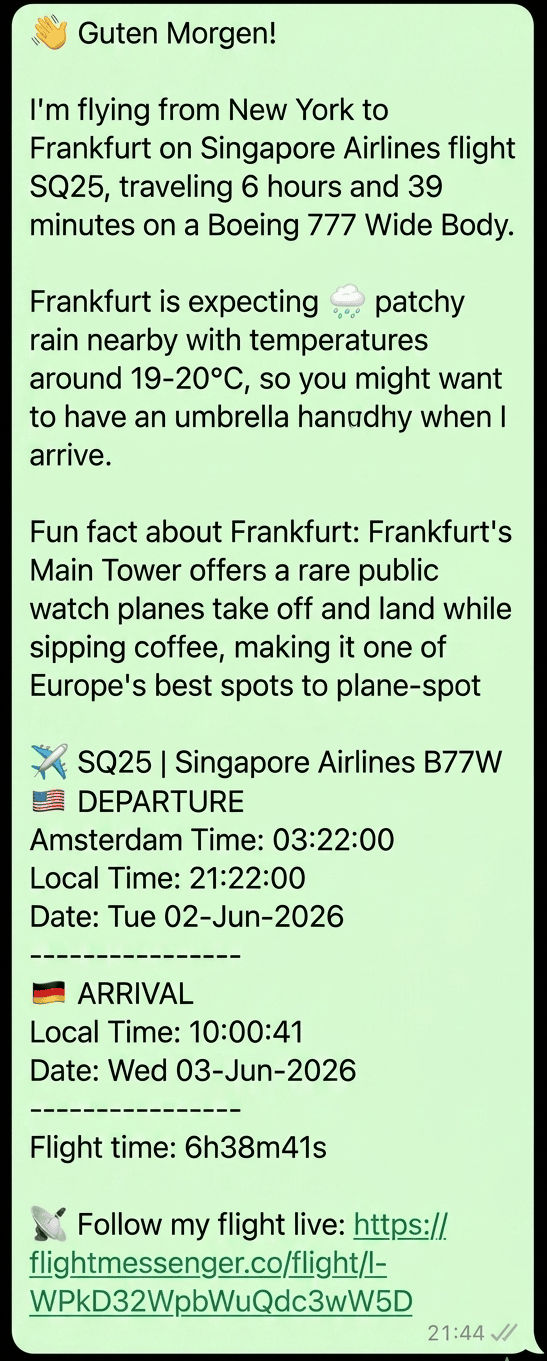
FlightMessenger does the conversion for you. The flight message shows the departure time in the local time of the departure airport and the arrival time in the local time of the arrival airport, together with the flight duration, based on live flight data for your flight number and date.
The live tracking page goes one step further. It shows all times in the viewer's own time zone by default, so your parents at home see when you land in their time, while the person waiting at the destination sees the local arrival time. Anyone can switch the page to another time zone with one tap. Countdowns to takeoff and landing avoid the question completely: "lands in 2 hours 10 minutes" means the same thing everywhere.
A quick summary
- Ticket times are always local to each airport.
- Arrival time equals departure time plus duration, adjusted by the time difference on your travel date.
- Check for +1 or -1 and always mention the date.
- Daylight saving time changes the difference between cities on different dates.
- Tell people at home the arrival time in their own time zone, or send them a link that converts it for them.